More deals.Same team. Same standard.
Every claim, traced to the page behind it.
Vurdera reads the deal folder and drafts the IC memo. Every claim links to the page it came from. What the documents don't cover gets flagged rather than written around. Drafting goes from 20–40 hours to about an hour of review.
We will run one of your own past deals through it, free. You keep the memo either way.
The memo is the bottleneck.
Two analysts can only properly assess so many deals in a month. Every additional deal competes for the same limited hours.
20–40
analyst hours before the committee sees anything
~6
committee hours spent on a document it cannot interrogate
1–2 days
to get one committee question answered
From documents to decision.
Vurdera turns your deal documents into a cited, committee-ready investment memo, without the manual work.
-
01
Select the folder
PDF, Word, PowerPoint or Excel. A free pre-flight check shows you what can be read before anything runs.
-
02
Vurdera reads the documents
It works through the folder before drafting, with each factual claim tied back to its source document and page.
-
03
Get the first draft
The memo follows your section structure. Factual claims are cited, and missing information is flagged rather than filled in.
-
04
Review and export
Work through the draft with your team, check the underlying sources and export the finished memo to Word.
Deals reviewed per analyst-month
3
30
Traditional process
20–40 hours per deal spent reviewing documents, assembling the analysis and writing the memo.
With Vurdera
About an hour to review the draft and check the underlying claims.
You can only pick from what you looked at.
Time spent assembling a memo is time not spent finding and assessing the next opportunity. The analyst’s time moves from assembling the memo to interrogating it.
Every claim. Every source.
A drafted section, and the passage behind the claim you clicked. Open the real document at that page and the sentence is there. Any committee member can check a number, or question the data room at 2am, without emailing the associate.
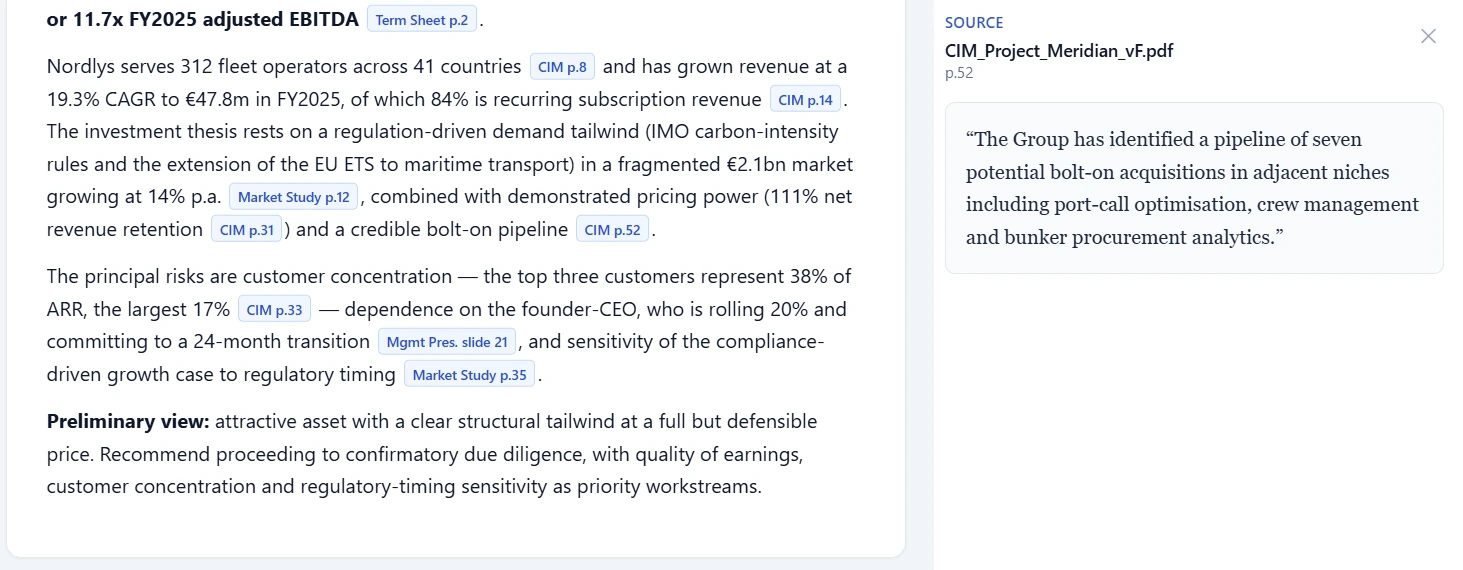
Source everything
Every claim carries a chip naming its document and page. After drafting, each citation is matched back against the text of that page. Plain string and number matching, not a model grading its own work.
Surface what is missing
Where the documents are silent, the memo says so instead of writing a confident sentence. A gap found before the committee meets costs a phone call. Found in month three of diligence, it costs weeks.
Refuse to invent
Ask something the documents don’t answer and it says so, then lists what it would need to answer properly. It will not fill the gap with something plausible.
Audit the memo
Every cited claim traced to the passage behind it, which sections rest on which sources, and which passages the draft never used. Computed from the memo itself, so it cannot drift from what the memo says.
What happens to your documents and data.
Processed, then discarded
You select documents on your own device. They are sent over an encrypted connection, processed for that request, and discarded when it completes. There is no document repository, no file store and no vector database. Nothing on our side holds your data room.
Never used for training
Analysis runs on the Anthropic API under commercial terms: your content is not used to train models. We add no training pipeline of our own, because we keep no copy to train on.
Your own tenant, where required
For firms that cannot send deal material to a third-party API, the same product runs inside your own AWS or Google Cloud tenant, so the only traffic is your machine to your model endpoint.
Read-only for the committee
The committee view cannot edit, regenerate or export the memo, and questions never touch the draft. The audit trail is computed from the memo, so it cannot be edited into disagreeing with it.
You have four other options.
| Option | What you get | Where it breaks |
|---|---|---|
| Keep doing it manually | Full control, and the reading stays in one person's head. | 20–40 hours a memo. Gaps found late. The committee still cannot check anything. |
| A general AI assistant | A draft, quickly, at consumer-tool prices. | No citations you can verify against a page. It answers when it should refuse. No committee seat, no audit trail, and your deal documents sit in a consumer product. |
| Hire another analyst | Judgment, relationships, someone accountable. | $150k and six months of ramp, and they still cannot answer your committee at 2 in the morning. |
| An enterprise research platform | Broad market data, deep search, an established vendor. | Priced per seat, well into five figures a year, and built for research across markets rather than one defensible memo from one data room. Procurement takes months. |
Vurdera gives you a cited, gap-flagged IC memo from the deal docs you already have, and a seat where every committee member can question the data room themselves.
Priced against the work it replaces.
Priced on the size of your team and how many deals you put through it, so the number tracks the work it takes off your analysts.
Most engagements
$1,500–$6,000/ month
One memo, drafted the current way
$1,500–$5,000of analyst capacity
What you are never billed for
Per document. Per token. Committee seats.
What determines your price
- Team size. How many analysts and associates draft memos.
- Deal volume. How many opportunities you put through appraisal each month.
- Deployment. Our infrastructure, or Vurdera running inside your own cloud tenant.
- Enterprise requirements. Single sign-on, a data processing agreement, security review support, custom contractual terms.
What it is not
- No per-document or per-token billing. A month where you evaluate thirty deals never produces a surprise invoice.
- Committee members do not consume seats. They read, question and audit memos without a licence.
Order of magnitude
One memo drafted by hand costs $1,500–$5,000 of analyst time, before the committee hours spent checking it. At the bottom of our range that is one memo a month to break even.
Quoted monthly, billed monthly or annually.
Frequently asked questions
How do I know it is not making things up?
Vurdera uses two checks.
First, every factual claim in the memo must have a source, and each citation is checked against the text of the page it cites. This is based on direct text and number matching rather than asking another model to decide whether a claim is correct. If a claim cannot be supported, it is flagged rather than included without a source.
Second, Vurdera is designed to say when the documents do not contain the answer. If you ask for an internal rate of return and there is no financial model in the data room, it will say so and tell you what information is missing. It does not fill gaps with assumptions.
Our deal documents are strictly confidential. Where do they go?
You select your documents on your own device. They are transmitted over an encrypted connection and analysed through the Anthropic API under commercial terms that do not allow your data to be used for model training. The documents are discarded from our processing environment once the request is complete.
Vurdera does not maintain a document repository, file storage or vector database. Generated memos are stored locally rather than on any external servers.
For firms that cannot send documents to a third-party API, Vurdera can also run inside your own cloud environment on the Enterprise tier. Full details are set out in our Privacy Policy.
Our investment memos follow a specific house format. Can Vurdera match ours?
Yes. During onboarding, you provide your section headings and the requirements for each section. Vurdera then drafts the memo using that structure. We set this up with you as part of onboarding.
Our data room is full of scanned documents. Can Vurdera read them?
Not yet if the scans contain no text layer. Before a run, Vurdera performs a pre-flight check and shows you which documents can be read and which will be excluded. You therefore know exactly what the memo is based on before it is generated.
How quickly can we get started?
You can generate a first memo from an existing deal folder within minutes. There is no data migration, integration work or IT deployment required. Setting up your house template takes one onboarding call.
Can we pilot it on a single deal before committing?
Yes. That is how we prefer to start. The pilot is free.
Send us a deal you have already closed, ideally one where you know the outcome, and we will run it through Vurdera and walk you through the output claim by claim. You keep the memo regardless of whether you decide to continue.
Is Vurdera going to replace our analysts?
No. Vurdera handles the information assembly and produces the first draft. Your team still makes the investment judgment, decides on the recommendation and remains responsible for the final memo.
Could we not just do this with a general AI assistant?
You can use a general AI assistant to produce a draft. Vurdera is built around the parts of the process that come after the draft: citations that can be checked against the source document, explicit handling of missing information, house-format memos and an audit trail.
The drafting is the easy part.
See it on a deal you already know.
Send us a deal you have already closed. We will run it through Vurdera and walk you through the memo it produces. Every claim cited to your own documents, every gap it found stated plainly. You keep the output whatever you decide about the rest of it.
Prefer email? Write to sales@vurdera.com.